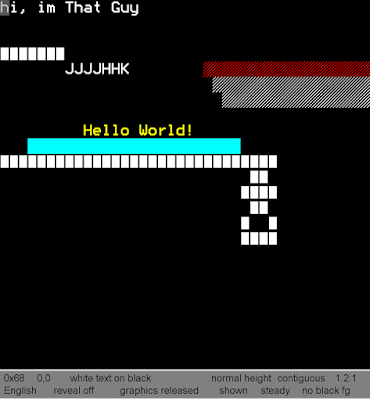
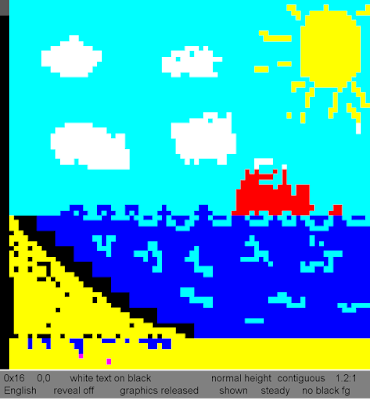
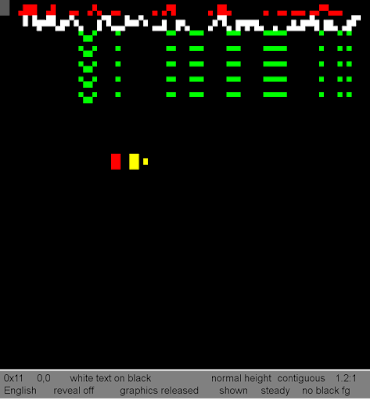
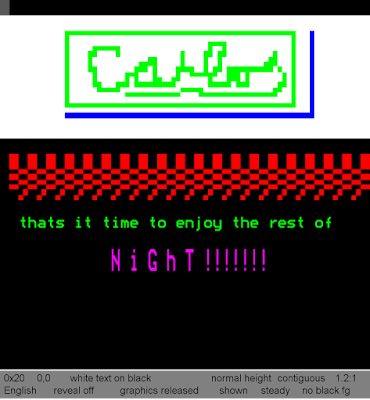
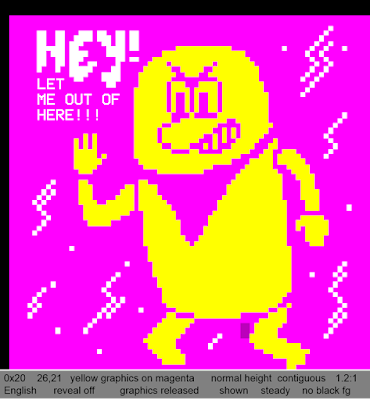
Artwork from the teletext art workshop held at #lateattate, Friday 5 June 2015. Open a page in the Teletext40 online editor
by simply clicking on the desired image... and carry on editing, if you
so wish! Send completed artwork to teletext40 [at] gmail [dot] com for
inclusion on teletext40.com.
Monday, 8 June 2015
Teletext Block Party // Tate Britain, 5 June 2015 // T40 editor art PART 2
Artwork from the teletext art workshop held at #lateattate, Friday 5 June 2015. Open a page in the Teletext40 online editor
by simply clicking on the desired image... and carry on editing, if you
so wish! Send completed artwork to teletext40 [at] gmail [dot] com for
inclusion on teletext40.com.
Teletext Block Party // Tate Britain, 5 June 2015 // T40 editor art PART 1
Artwork from the teletext art workshop held at #lateattate, Friday 5 June 2015. Open a page in the Teletext40 online editor by simply clicking on the desired image... and carry on editing, if you so wish! Send completed artwork to teletext40 [at] gmail [dot] com for inclusion on teletext40.com.
Thursday, 4 June 2015
Join the Tate Britain Block Party!
- Choose a template from here.
- Create your teletext page. See here or ask for help.
- When done, bookmark the page! The URL reflects the make up of the page itself and should look something like this:
4. Look for your page on teletext40.com in the coming days!
Wednesday, 3 June 2015
Prepping for TATE Britain Block Party...
With only a couple of days to the Tate Britain workshop, Raspberry Pi preparations are moving on apace.
Pics from @Illarterate and @That_Other_Carl
Teletext specs
Canvas: 40w x 24h character codes (80w x 72h 'pixels')
Colours: 7 (and black)
Broadcast Teletext Specification is here.
The Enhanced Teletext Specification document is here.
Did you know?
[Ceefax and ORACLE] were originally incompatible; Ceefax displayed pages of 24 lines with 32 characters each, while ORACLE offered pages of 22 lines with 40 characters each. In other ways the standards overlapped; for instance, both used 7-bit ASCII characters and other basic details. In 1974 all the services agreed a standard for displaying the information. The display would be a simple 40 × 24 grid of text, with some graphics characters for constructing simple graphics. The standard did not define the delivery system, so both Viewdata-like and Teledata-like services could at least share the TV-side hardware (which at that point in time was quite expensive).http://en.wikipedia.org/wiki/Teletext#History
Subscribe to:
Posts (Atom)